Showing posts with label Artefact. Show all posts
Showing posts with label Artefact. Show all posts
Saturday, 15 January 2011
Artefact Lesson 11th Jan
Well unfortunately I am quite a bit behind on my shoe as I had a Modrock disaster (see previous blog for more info!) and I now haven't finished tissue papering my shoe last! I have a genuine concern it will NOT be ready for 25th Jan but maybe I just need to work harder and have a bit more faith!

Thursday, 16 December 2010
Tools used in shoe making (burrowed from Beth's blog, hope she doesn't mind!)
 |
 |
| Hammer, obviously used to hammer in nails and similar things |
 |
| Brush, maybe used to brush the leather? |


Shoe making in the 19th century
Information and pictures taken from 'The Book of Trade, or, Library of the Useful Arts' by J.Johnson, published in 1807
Part II
 This illustration shows the master and the journeyman shoe-maker in the process of making a shoe. The master (pictured in front) is cutting out an upper leather of a shoe by cutting around a paper pattern. He has placed a weight at the corner to stop it slipping; also on his right are a pair of pincers made from teeth, used to grip the leather tight to stretch it. To his left is a hammer to beat down any rough parts standing up inside the leather. In the background is the journeyman shoe-maker. He is joining the upper leather to the sole of the shoe. Next to him on the bench are an awl (used to make holes in the leather), a knife and a stone used to sharpen his tools. On his right are a hammer and a lapstone, and on the other side is a large bucket of water. In this bucket he keeps a number of wax in balls; all these materials are necessary in his trade. The leather is sewn together with wax-coated thread and a hog's bristle instead of a needle (this guides the thread through the holes made by the awl in the leather better).
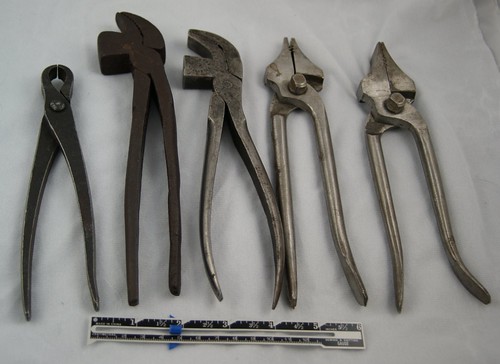
 Old cobbler's tools from 1880-1910, found at Charles Roberts' Wagon Works at Horbury Bridge, Wakefield. Not sure what they're exactly for but they did repairing as shoes then were expensive to replace.
 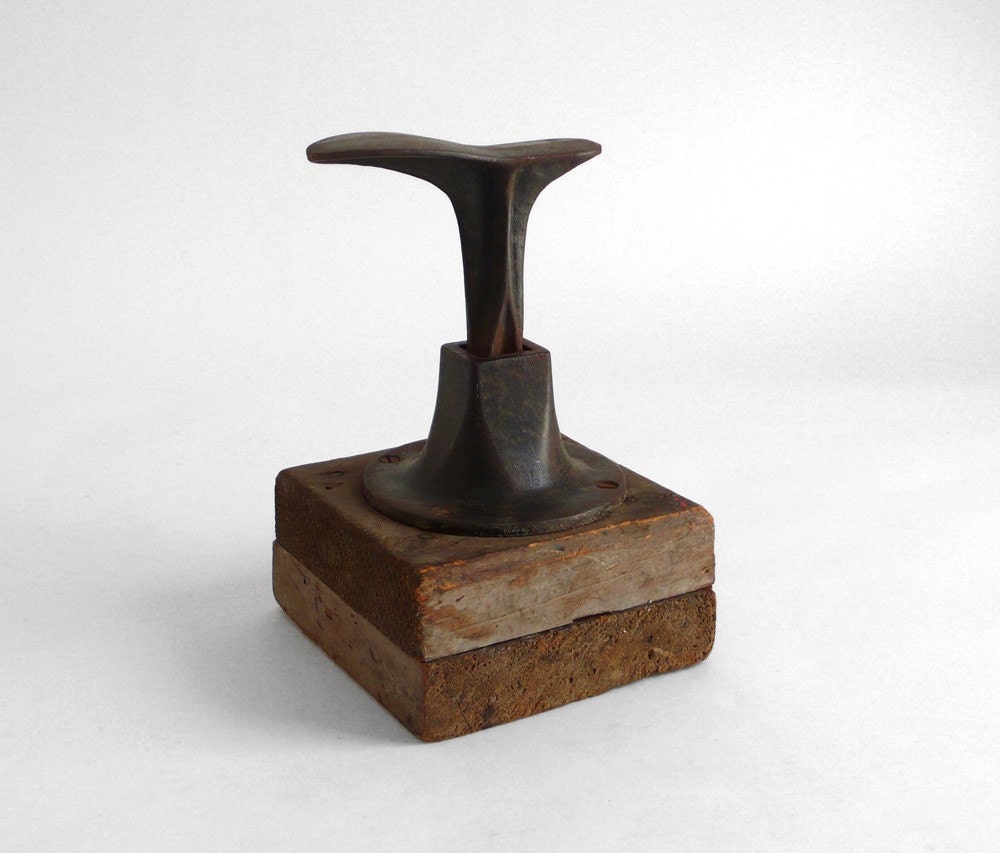 An old cobbler's tool made of cast iron with a large wood block base.
Part II
At the time when this book was published (early 19th century) shoe-making was a fairly profitable business; some shoe-makers owned huge shops with large window displays showing off their designs to rich men and women. The shoe-maker himself would buy his leather in half-hides and skins; keeping some for his business and selling the rest on to other shops. He would always be very knowledgeable in the type of leather he was using.
 This illustration shows the master and the journeyman shoe-maker in the process of making a shoe. The master (pictured in front) is cutting out an upper leather of a shoe by cutting around a paper pattern. He has placed a weight at the corner to stop it slipping; also on his right are a pair of pincers made from teeth, used to grip the leather tight to stretch it. To his left is a hammer to beat down any rough parts standing up inside the leather. In the background is the journeyman shoe-maker. He is joining the upper leather to the sole of the shoe. Next to him on the bench are an awl (used to make holes in the leather), a knife and a stone used to sharpen his tools. On his right are a hammer and a lapstone, and on the other side is a large bucket of water. In this bucket he keeps a number of wax in balls; all these materials are necessary in his trade. The leather is sewn together with wax-coated thread and a hog's bristle instead of a needle (this guides the thread through the holes made by the awl in the leather better).
Journeyman were highly skilled at making women's shoes; these required greater ingenuity due to the finer materials and smaller stitches. Women were employed to bind the shoe together and sew together those made of higher quality material such as silk or satin.
However these old fashioned-techniques of making shoes by hand were revolutionised in 1883, when an invention by Suriname-born Jan Matzeliger was patented in Lynn, Massachusetts. It was an automatic shoe-lasting machine that made it possible to make 150-700 pairs of shoes a day-14 times more than a person could! It went into production in 1885 and cut the prices of shoes in half-meaning they were now affordable to the average American.
(Information courtesy of Dean K. Anderson and Stamponhistory.com).
Pincers used in shoemaking (the far left one is 18th century, the second left is early 19th century and the other 3 are modern).
Old cobbler's tools from 1880-1910, found at Charles Roberts' Wagon Works at Horbury Bridge, Wakefield. Not sure what they're exactly for but they did repairing as shoes then were expensive to replace. An old cobbler's tool made of cast iron with a large wood block base. Artefact Lesson 14th Dec
I had a fairly major disaster in the lesson today! After being left for a while my Modrock shoe had dried and in order to make a heel and carry on with the work I was required to remove it from the shoe last by cutting it off with a knife. To do this I cut off the sole of the shoe so I could remove the top part and then use Modrock to stick the two parts back together. However the sole was very flimsy so I covered it in more wet Modrock to try and get it to stay together, which didn't work too well! It was extremely difficult to get the two parts together and eventually the top bit fell apart. It would have been impossible to fix so unfortunately I was forced to start again! After all my hard work! Anyway, this time I'm making it out of tissue papaer in the hope it will be easier. So far I have covered it in cling film and stuck a few ripped up pieces of tissue onto it with PVA glue.
Monday, 13 December 2010
Artefact Lesson 30th Nov
I spent this lesson working more on my shoe-I still haven't finished Modrocking and now I have to make the heel. It's taken much longer than I expected it to since I have never used it before but now we have a bit more time than I thought we did-I thought we had until the end of term but it turns out we have till the end of January! I need to now update my plan. Hopefully next lesson I will be able to start applying the jewellery and get it looking like a proper shoe-very exciting!
Saturday, 27 November 2010
Artefact Lesson 23rd Nov
This lesson we looked at different ways to construct our shoes-Miss Pinnington showed us pictures of some artists work and how they used different materials for different effects. For example, Marion Mitchell documented a woman's life in shoes. Each stage in a woman's life; from childhood and her teenage years, to her twenties and thirties, and finally middle age and retirement was represented by a different type of shoe.
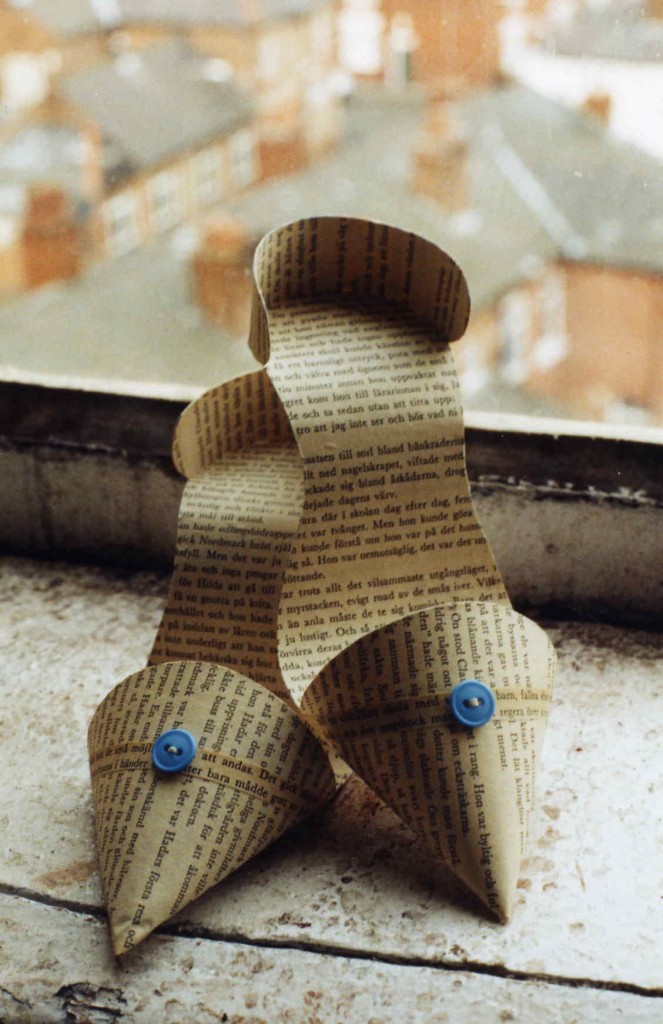 I also started production on my shoe! I began by covering my last with cling film; then I cut up some strips of Modrock, dipped them in water and pasted them onto my last. I still need to finish this before I can apply my jewellery but it's great!
Another really interesting idea was portrayed by Doris Salsedo; she covered her shoes with wax sheeting and kept then in a wax shoe box. They were made not to be worn but almost to be preserved, like they were really precious or she just wanted to remember them, even though she didn't wear them.
I also started production on my shoe! I began by covering my last with cling film; then I cut up some strips of Modrock, dipped them in water and pasted them onto my last. I still need to finish this before I can apply my jewellery but it's great!Tuesday, 16 November 2010
16th Nov - Trip to Florida Shoe Factory, Dibden Road, Norwich
This morning, we took the coach from Wymondham High to the Florida Shoe Factory in Norwich. They design and make shoes and handbags for Van Dal, a huge older women's shoe brand based in Norwich. Norwich is especially famous for making shoes (mainly for ladies and children) and have been a major part of the shoemaking industry for over 700 years! They once made around 7 million pairs a year, however since the mid 19th century the shoemaking process has become mechanised and because of the downturn during the war Van Dal now produce on average 1400 pairs a week. While they do produce shoes in thier own factory, the vast majority are now exported to China and India to be made in huge factories, as the cost of labour is cheaper out there.
The concept of a shoe starts in the design room, where the designers have their ideas and draw them out on paper before they can become a reality. However they don't have total creative freedom-they subscribe to the magazines 'Insight' (predicts the next seasons trends) and 'Pantone' ( a magazine which shows next seasons colours and patterns). Because they are designing for a certain market ( the over 45's) they have to use heel shapes, designs and materials which will appeal to their customers. They firstly have a design meeting, wher they are told by the managers which designs they like and think will work. The next step is a specification sheet-these are technical drawings of the shoe, with information about colour, materials and the general shape of the shoe. They also use theme boards which display images of a certain idea that the shoe design will be based around and colour boards, with different images all representing the same colour.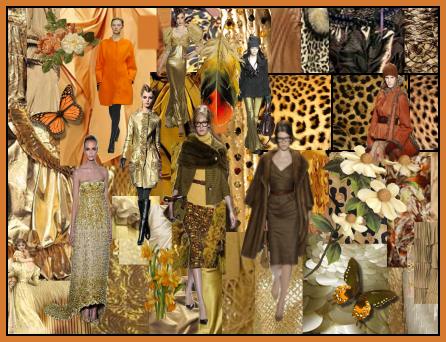 Theme-nature, flowers and animal print
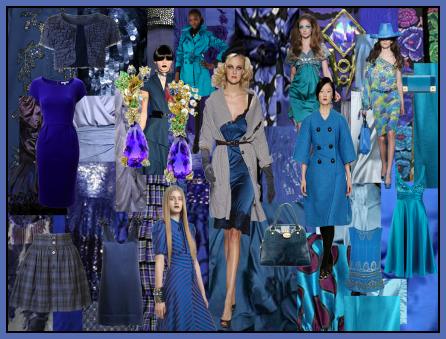 Colour-indigo and navy blue
After sending out spec sheets to the factories in Asia and getting samples sent back, the design is put onto the computer using a digitiser. They then edit on the computer to make sure that once made the shoe will fit comfortably and will fit together properly. Once satisfied, they send it the cutting table where the shapes are cut out onto card.
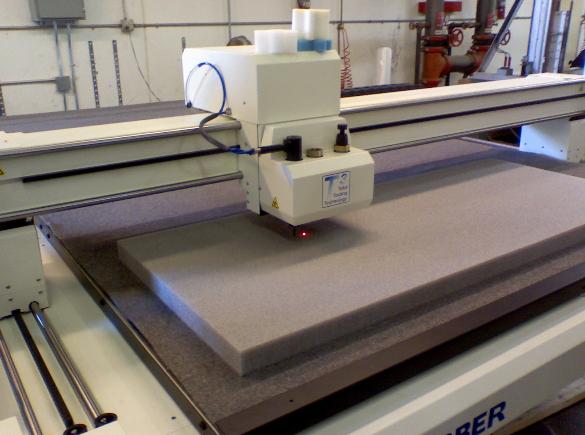 This is a different cutting table I found on the internet.
This process used to be done by clickers ( so called because they used to make a clicking sound ). They would cut the paper out by hand.
Next we headed downstairs where a lot of the work is done by hand. The card template is traced around and cut out onto leather and the pieces are sewn together by women on sewing machines. They pieces are moulded onto lasts and the stifler (back of shoe) is also moulded. The soles are stuck on with adhesive and any untidy fibres are burned, wiped and cleaned away.
The shoe boxes are made in flatpacks in China. These are shipped back to Norwich and sent to Norwich Prison, where the prisoners make them into proper shoeboxes.
 The labels are added, the shoes are put into boxes and are now ready to be sold!
This modern way of making shoes is quite different to back in the 19th century, when cobblers made shoes by hand, using traditional methods of sculpting the leather and sewing it all together. While some techniques have remained the same-they still use shoe lasts to model the shape of the shoe, although today they are mad of plastic rather than wood and made by machines.
The concept of a shoe starts in the design room, where the designers have their ideas and draw them out on paper before they can become a reality. However they don't have total creative freedom-they subscribe to the magazines 'Insight' (predicts the next seasons trends) and 'Pantone' ( a magazine which shows next seasons colours and patterns). Because they are designing for a certain market ( the over 45's) they have to use heel shapes, designs and materials which will appeal to their customers. They firstly have a design meeting, wher they are told by the managers which designs they like and think will work. The next step is a specification sheet-these are technical drawings of the shoe, with information about colour, materials and the general shape of the shoe. They also use theme boards which display images of a certain idea that the shoe design will be based around and colour boards, with different images all representing the same colour.
Theme-nature, flowers and animal printColour-indigo and navy blueAfter sending out spec sheets to the factories in Asia and getting samples sent back, the design is put onto the computer using a digitiser. They then edit on the computer to make sure that once made the shoe will fit comfortably and will fit together properly. Once satisfied, they send it the cutting table where the shapes are cut out onto card.
This is a different cutting table I found on the internet.This process used to be done by clickers ( so called because they used to make a clicking sound ). They would cut the paper out by hand.
Next we headed downstairs where a lot of the work is done by hand. The card template is traced around and cut out onto leather and the pieces are sewn together by women on sewing machines. They pieces are moulded onto lasts and the stifler (back of shoe) is also moulded. The soles are stuck on with adhesive and any untidy fibres are burned, wiped and cleaned away.
The shoe boxes are made in flatpacks in China. These are shipped back to Norwich and sent to Norwich Prison, where the prisoners make them into proper shoeboxes.
The labels are added, the shoes are put into boxes and are now ready to be sold!This modern way of making shoes is quite different to back in the 19th century, when cobblers made shoes by hand, using traditional methods of sculpting the leather and sewing it all together. While some techniques have remained the same-they still use shoe lasts to model the shape of the shoe, although today they are mad of plastic rather than wood and made by machines.
Sunday, 14 November 2010
Lesson 9th Nov
This lesson was mainly a re-cap on what we have to get done and a catch up for those who are behind. I finished my brainstorm and my shoe planning-after the trip to Florida Soes next week I will be ready to start making my shoe!!!! I have even chosen the shoe last my shoe will be modelled on and I will start by wrapping it in cling film and covering it in Modrock, which I have never used before. This will be a new experience!
Sunday, 7 November 2010
Research-Hunter Wellies and Comparisons with Irregular Choice
Wellington boots first appeared in 1817, as 19th century men's fashion underwent a change. They needed a suitable outdoor boot that would would go under trousers and were originally designed by Arthur Wellesley, Duke of Wellington,'s shoemaker (hence the name wellington boot). Firstly made of leather, entrepreneurs in America began experimenting with using rubber as an alternative. One man, Henry Lee Morris, came over to Scotland and the Hunter shoe brand was born.
Since its small beginnings in 1856 in Edinburgh, Hunter has now become iconic yet also modern and stylish. Once based in Heathhall Dumfries (in September 2008 it relocated back to Edinburgh) it has supplied our army with boots during both World Wars and in the winter of 1955 they created their most famous boot: the original Green wellington, copied by designers globally. The green welly is the ultimate symbol of the British countryside. Even the Royal Family have given Hunter a warrant and they are the official welly suppliers to HM the Queen and HRH the Duke of Edinburgh.
 Original Hunter Green Welly £62.00
While the obvious function of Hunter wellies is practical, as they keep your feet dry while walking on damp or muddy ground, the function of a more fashion-orienteered brand such as Irregular Choice is to make a statement and look good. Both brands are now iconic in their field, but Hunter dates back to literally 200 years while Irregular Choice was only launched in 1999. The materials used to make these shoes are also very different-wellies were traditionally made from calfskin leather, but now tend to be made from rubber or a synthetic alternative but modern fashion shoes are made from ordinary leather and sometimes embellished with ribbons, feathers, jewels, beads and laces.
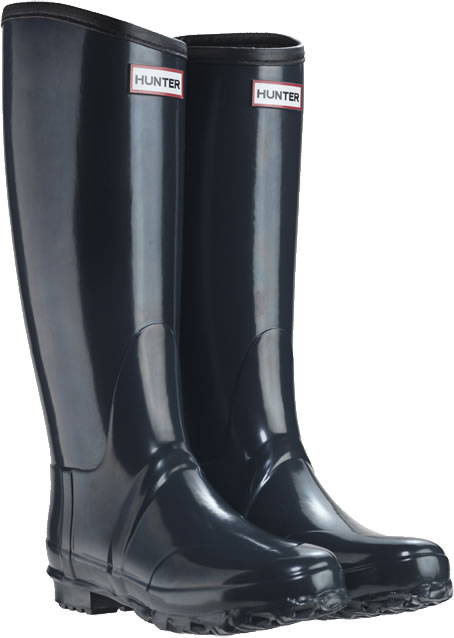 Black Hunter wellies made from Neoprene.


Since its small beginnings in 1856 in Edinburgh, Hunter has now become iconic yet also modern and stylish. Once based in Heathhall Dumfries (in September 2008 it relocated back to Edinburgh) it has supplied our army with boots during both World Wars and in the winter of 1955 they created their most famous boot: the original Green wellington, copied by designers globally. The green welly is the ultimate symbol of the British countryside. Even the Royal Family have given Hunter a warrant and they are the official welly suppliers to HM the Queen and HRH the Duke of Edinburgh.
Original Hunter Green Welly £62.00While the obvious function of Hunter wellies is practical, as they keep your feet dry while walking on damp or muddy ground, the function of a more fashion-orienteered brand such as Irregular Choice is to make a statement and look good. Both brands are now iconic in their field, but Hunter dates back to literally 200 years while Irregular Choice was only launched in 1999. The materials used to make these shoes are also very different-wellies were traditionally made from calfskin leather, but now tend to be made from rubber or a synthetic alternative but modern fashion shoes are made from ordinary leather and sometimes embellished with ribbons, feathers, jewels, beads and laces.
Black Hunter wellies made from Neoprene. |
| Irregular Choice 'Rasperberry Ripple' heels made with fabric and ruffles. |
Wellies need to look the way they do; while they can be seen as a fashion statement, wellies are generally worn by people working in the countryside who need practical, comfortable shoes that are easy to clean and offer protection against the elements. The sole and very low heel are designed to be comfortable also, as well as helping feet to grip the uneven surface of country roads, grass and hills. While you can get wellies designed to look pretty and colourful, traditional wellies are generally plain colours such as green and black, as they are more about practicality and function rather than fashion.
On the other hand, Irregular Choice and other high street and designer brands are designed to keep up with current trends (at the same time being individual) and looking good; comfort is not always the idea. While there are shoes like wedges, which claim to be more comfortable, high heels with tight straps and pointy toes are generally much more painful to wear than wellies! Furthermore, companies like Hunter that produce wellies stick to the same shape and styles, whereas top-end famous designers are renowned for pushing boundaries with shoe design. For example, Antonio Berardi designed some thigh-high leather heel-less boots famously worn by Victoria Beckham...
....as well as the 'Armadillo'boots worn by Lady Gaga in her 'Bad Romance' video. They were designed by Alexander McQueen and had a style similar to ballet pointe shoes, witha blocky end going straight down and encrusted with sparkle.
Theses shoes may have had a mixed reaction, but the whole point of them was to look unique, to be different and experimental, rather than be used for work and comfort in the countryside.
Artefact Lesson 2nd Nov
We were finally given our sketchbooks this lesson and also a sheet on our deadlines! Next lesson we have to submit our LO1 and LO2 portfolio and then on the 16th we have a trip to Florida Shoes in Norwich were we will see how proper shoes are made and get more information on how to construct our shoes. Then on the 23rd we will begin making our final shoes!!!
Wednesday, 27 October 2010
Shoe Story-Fashion Drawings
Here are some fashion drawings of shoes that I drew from designers like Armani, Dior, Alexander McQueen and Balmain. These are also copies of pictures from fashion magazines and while some of the shoes have a fairly simple design and are quite easy to draw, the most difficult shoe was very complicated! It was by Dior and had a fertility figurine as a heel. It made me realise how much time and effort it should take to make a true fashion drawing of your own design as they have to be exact, otherwise you could end up with the shpoe looking completely different to what you wanted.


Shoe Story-Mood Board

Tuesday, 19 October 2010
19th October-Artefact lesson
Today Miss Pinnington talked us through our 4 Learning Outcomes and what we are expected to achieve during the Artefact unit. It was useful to know that we must always update our blogs. We also began to plan our shoes and create mood boards. I'm doing a shoe for Hemstock's Jewellers, so one of my ideas was to use wire, beads and buy lots of cheap jewellery and use them to make and decorate my shoe. This would hopefully be something I could make in the lesson and at home and should be finished in the designated time.
Sunday, 3 October 2010
Fashion Drawings


 These are some shoe fashion drawings I found on the Internet when I typed 'fashion drawings-shoes' into Google. The bottom image shows a shoe developing over time, with the first picture being just a shoe last and then the shape and design becomes clear. The second one is someone's drawing of a designer shoe (not sure which designer, possibly a Topshop shoe?). However the firt one looks more like a print or like it's been layered over a seperate piece of paper.
 Tuesday, 28 September 2010
Irregular Choice

£44.99
£74.99

 £54.99
 £59.99
  £59.99
"Recapture your freedom which eloped with your youth".
Irregular Choice was launched in Brighton in August 1999 by design entrepreuner Dan Sullivan. The idea was to create a brand that would stand out and maintain creativity and individuality. Inspired by London's Kings Road in the 1970's, where it was all about being imaginative and standing out from the crowd. Dan saw that he could launch his fun, unique footwear line and it has been a huge success, with stores in New York and London.
Dan Sullivan came from a design background, which later influenced to create his iconic footwear range-his first collection was inspired by the traditional Japanese split-toe which occasionally reappears in collections. Over the past 10 years it has become a huge individual brand, constantly pushing boundaries and exploring new ideas. Collaborations with Heatherette, Emma Bell and Akomplice have further added to Irregular Choice's impressive amazingness and now they also have a handbag line, clothing and a girls sneakers range called ICED.
Irregular Choice was launched in Brighton in August 1999 by design entrepreuner Dan Sullivan. The idea was to create a brand that would stand out and maintain creativity and individuality. Inspired by London's Kings Road in the 1970's, where it was all about being imaginative and standing out from the crowd. Dan saw that he could launch his fun, unique footwear line and it has been a huge success, with stores in New York and London.
Dan Sullivan came from a design background, which later influenced to create his iconic footwear range-his first collection was inspired by the traditional Japanese split-toe which occasionally reappears in collections. Over the past 10 years it has become a huge individual brand, constantly pushing boundaries and exploring new ideas. Collaborations with Heatherette, Emma Bell and Akomplice have further added to Irregular Choice's impressive amazingness and now they also have a handbag line, clothing and a girls sneakers range called ICED.
Hemstock's Jewellers-our shoe design company!
In the artefact unit of CRAM, we have to design a shoe for a local Wymondham shop. My group (me, Charlotte, Beth and Laura) picked Hemstock's Jewellers, a local company with branches in Wymondham and Diss I'm really pleased with this as a jewellers gives you lots of ideas to work with and lots of inspiration.
Hemstocks have been selling jewellery for 25 years and are also members of the National Association of Goldsmiths, who promote ethical working conditions and education for their staff.
I didn't go with my group to the shop so I'm not sure what would look good and go with Hemstock's designs but my idea is to embellish my shoe with lots of sparkly jewellery and chains, studs, gems etc.
Hemstocks have been selling jewellery for 25 years and are also members of the National Association of Goldsmiths, who promote ethical working conditions and education for their staff.
I didn't go with my group to the shop so I'm not sure what would look good and go with Hemstock's designs but my idea is to embellish my shoe with lots of sparkly jewellery and chains, studs, gems etc.


Friday, 24 September 2010
Making shoes - the history of shoe-making in Norwich!
The Van Dal factory in Norwich opened in 1918 and specialised in making womens shoes out of materials like leather, kid and snakeskin. In the 1920s they also began to specialise in brocade and reptile skin-women didn't go out to work so they didn't need endurance shoes like men. The factory was mainly run by men who made the actual shoe and cut the material-women stayed at home doing the finer, detailed work on the shoes. They became huge and exported globally.
Start-rite opened in Norwich in 1792! but only started making children's shoes in 1918. They were the first to measure children's feet in width and length to make sure they got the right shoe size. and also invented the supportive V-heel to make sure childrens feet were properly supported.
Van Dal in 1964 employed thousands of workers and made 30,000 pairs oof shoes a week. As industry progressed they began to ship parts out to China and have the shoes made there as it was cheaper. However they were seent back to Norwich to have the soles put in so they could still say they were made in Norwich.
Start-rite opened in Norwich in 1792! but only started making children's shoes in 1918. They were the first to measure children's feet in width and length to make sure they got the right shoe size. and also invented the supportive V-heel to make sure childrens feet were properly supported.
Van Dal in 1964 employed thousands of workers and made 30,000 pairs oof shoes a week. As industry progressed they began to ship parts out to China and have the shoes made there as it was cheaper. However they were seent back to Norwich to have the soles put in so they could still say they were made in Norwich.
Subscribe to:
Posts (Atom)